

How to Learn American Mahjong: A 2026 Beginner Guide
Table of Contents
- What You Need Before Your First Game
- The National Mah Jongg League Card Explained
- How to Set Up the Table and Deal Tiles
- Basic Rules and Game Mechanics for Beginners
- The Charleston: Passing Tiles to Build Your Hand
- How to Call a Mah Jongg and Win the Hand
- American Mahjong Etiquette and Social Play
- Best Online Platforms to Learn Mahjong
- Frequently Asked Questions
Last Updated: September 16, 2026
What You Need Before Your First Game
Learning how to learn american mahjong starts with one piece of equipment most beginners don't know exists: the National Mah Jongg League card, a yearly-issued scoring guide that defines every legal hand for the American variant. Newcomers often arrive clutching a rulebook for the Chinese game, then wonder why nothing matches the table.
Before your first game, you need four things:
- A set of 152 tiles, including Jokers, Flowers, and the eight Winds and Dragons
- Four racks for holding and organizing your hand
- The current year's NMJL card, one per player
- A table with enough room for four racks, a wall, and a central discard pile
The National Mah Jongg League Card Explained
The NMJL card is a folded reference sheet listing every hand you're allowed to build that year, organized by category, and it is the single most important object at the table. Without it, American Mahjong has no win condition. The League publishes a new card every year, so an old card is worthless.
How to Read a Hand Entry
Every hand is written in a shorthand that looks like code until someone decodes it. Take this line:
FF 222 444 666 888 DDDD
Read it left to right:
- FF = two Flowers. The letter stands for the tile, and the count is the number of letters.
- 222 444 666 888 = four Pungs of even numbers. Each group of three digits is one Pung (three identical tiles). No suit letter is attached, so any suit works for each Pung, but the numbers must be even (2, 4, 6, 8).
- DDDD = four Dragons. Any Dragon suit works unless the card specifies a color.
A few decoding rules that apply across the card:
- A letter with no number (F, D, N, E, W, S, and so on) means one tile of that type per letter shown.
- A number with no suit letter means you choose the suit, but every Pung in that group must use a different suit when the card says "Like Numbers."
- A number with a suit letter (for example, 3C for 3 Craks) locks that tile to that suit.
- X means any tile of that number, and 0 on some cards means a Flower or Joker substitute.
- NEW printed beside a hand means it was added that year; closed or a symbol beside the hand means you cannot expose tiles to complete it.
Open vs. Closed Hands
A practical drill for your first week: pick three hands from three categories, write each in plain English ("two Flowers, Pung of 2s, Pung of 4s..."), and keep that translation beside you during play. Most beginners find the card readable within a few sessions.
How to Set Up the Table and Deal Tiles
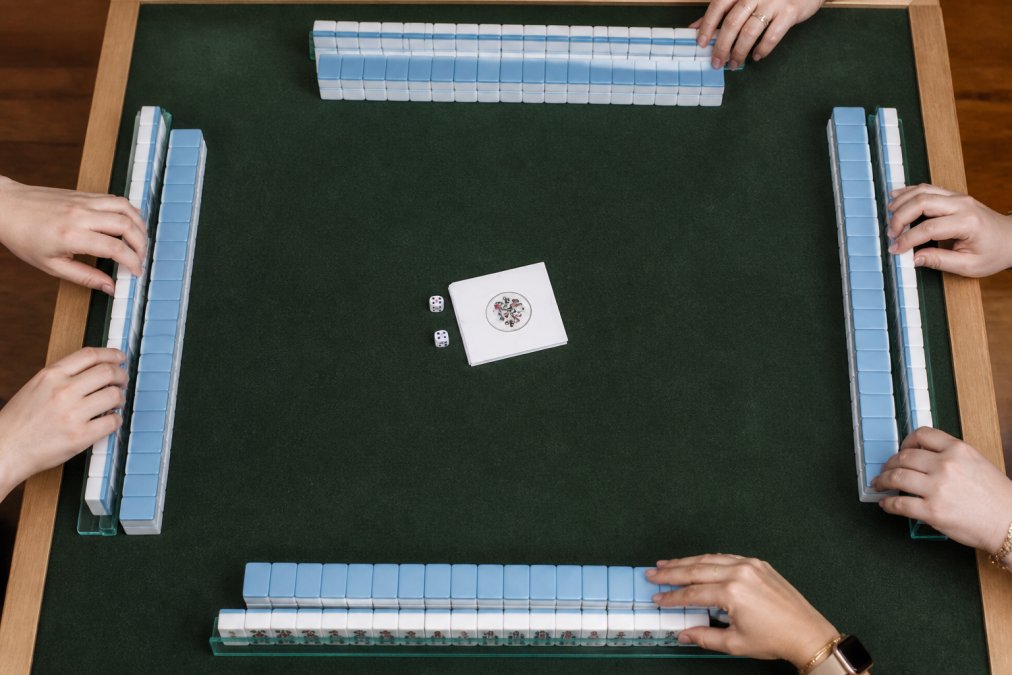
- Each player builds a wall of tiles in front of their rack, stacked two high
- The four walls are pushed together to form a hollow square
- One player rolls the dice to determine the break point in the wall
- Tiles are dealt from the broken wall, thirteen to each player
- The dealer takes fourteen and discards first to begin play
Basic Rules and Game Mechanics for Beginners
Play proceeds counterclockwise: draw a tile, evaluate your hand, discard one. The discard pile sits in the center, and any player may claim a discarded tile to complete a Pung, Kong, Quint, or Sextet that fits a hand on the card.
The Charleston: Passing Tiles to Build Your Hand
The Charleston is a three-tile exchange before play begins, and it's the mechanic that separates American Mahjong from nearly every other variant. Players pass tiles in a set sequence, right, across, left, with an optional reversed second round. Your initial thirteen tiles are random, and the Charleston lets you trade dead weight for tiles that fit a hand you can pursue.
The Sequence, Step by Step
- First Charleston (mandatory): pass three tiles to the right, then three across, then three to the left. Nine tiles leave your hand and nine arrive.
- Second Charleston (optional, agreed before the hand): pass three to the left, three across, three to the right, the reverse of the first round.
- Courtesy pass (optional): after the second Charleston, players to your left and right may agree to exchange one, two, or three tiles. Both players must agree on the count. If either declines, no pass happens.
You must pass exactly three tiles each round, and you cannot pass Jokers. You can pass Flowers, but doing so usually signals you're not chasing a Flower hand. After the Charleston, play begins and no more exchanges happen.
What to Actually Pass
This is where the Charleston stops being a formality and starts deciding hands. A workable framework:
- Before you pass anything, sort your tiles by suit and by number. You cannot see a hand pattern in an unsorted rack.
- Identify your two strongest candidate hands on the card. Look for hands where you already hold four or more required tiles. Two candidates is enough, three is noise.
- Pass tiles that fit neither candidate. A lone 9 of Bams when both candidates are even-numbered hands is dead weight.
- Keep Jokers. They substitute in Pungs and Kongs, so never pass or discard one early unless forced.
- Keep pairs. A pair is one tile away from a Pung; a single is two tiles away.
- Watch what comes back. Pass a 4 of Dots to the right and get one back from the left, and you've learned something about the table's suits.
Reading the Table During the Charleston
The Charleston is your only window into other players' hands before discards start. Patterns to watch for:
- A player who passes Flowers is not building a Flower hand. Safe to assume they're chasing numbers.
- A player who passes the same suit three times is likely collecting that suit and dumping everything else.
- A player who hesitates is often deciding between two candidates, useful information about what they're holding.
Common Charleston Mistakes
- Passing a tile you'll need for the hand you're actually building. Sort first, decide second, pass third.
- Forgetting the second Charleston is optional. Some groups skip it for time. Ask before your first hand so you're not the one holding three tiles while everyone else has passed.
The courtesy pass catches beginners off guard, agree on the count with your neighbor before pulling tiles, or you'll both sit there holding three and waiting.
How to Call a Mah Jongg and Win the Hand
Calling "Mah Jongg" ends the hand, and you can only do it when your fourteen tiles exactly match a hand printed on the NMJL card. Not close. Not thematically similar. Exact.
American Mahjong Etiquette and Social Play
Etiquette matters more in American Mahjong than in most games, because it's fundamentally a social ritual, played at kitchen tables and community centers where the game is half the point and the company the other half.
The unwritten rules are straightforward:
- Announce your discard clearly so the table can hear it
- Don't rush the player to your left
- Keep commentary on other players' hands to yourself
- Verify a Mah Jongg declaration politely, not triumphantly
- Help a beginner who's clearly stuck
Best Online Platforms to Learn Mahjong
Online platforms work best as a supplement to real-table play, not a replacement, useful for drilling the card and mechanics before you sit down with three other people.
| Learning Method | Best For | Watch Out For |
|---|---|---|
| Online platforms | Memorizing the card, rule drills | Weak social cue training |
| Local classes | Beginner confidence, live feedback | Limited schedule availability |
| Home games with friends | Regular practice, real pacing | Bad habits passed between beginners |
| Video tutorials | Visual learners, rule review | No interaction or correction |
Frequently Asked Questions
Is American mahjong difficult to learn?
American mahjong has a steeper learning curve than the Chinese variants because of the NMJL card, but most beginners can play a full hand within two or three sessions. The rules themselves are simple: draw, discard, and build a hand that matches a pattern on the card. The challenge is learning to read the card and recognize valid combinations quickly. With regular practice, you will feel comfortable within a few weeks.
Can you learn Mahjong by yourself?
Yes, you can learn the basics solo by studying the NMJL card and practicing tile combinations. Many online platforms offer solo drills that teach you to spot valid hands. However, the Charleston and social flow of the game are best learned with others. Consider joining a local group or class to practice with experienced players who can guide you.
Is there an app that teaches you how to play American mahjong?
Several apps and online platforms offer American mahjong tutorials and practice games. Look for ones that use the current NMJL card and let you play against computer opponents or other learners. These are great for memorizing hand patterns and practicing the Charleston. Just remember that app play cannot fully replicate the table talk and etiquette of in-person games.
What equipment do I need to start playing American Mahjong?
You need a set of 152 tiles (including Jokers and Flowers), four racks, dice, and the current National Mah Jongg League card. A table cover or mat helps keep tiles from sliding. Many beginners start with a basic set and upgrade later. The Rabbit Hole Stitchery in Columbia, MO, carries mahjong accessories.